Pokazywanie postów oznaczonych etykietą Grecja - Greece. Pokaż wszystkie posty

czwartek, 14 marca 2013

Monastyr Świętego Mikołaja Odpoczywającego, Meteory, The Monastery of St. Nicholas Anapausas, Meteora

Monastyr Świętego Mikołaja Odpoczywającego jest jednym z sześciu monastyrów w kompleksie Meteory w Grecji. Jest najmniejszym z zamieszkałych monastyrów.

The Monastery of St. Nicholas Anapausas is one of the six monasteries of the Meteora in Greece. It is the smallest of the inhabited monasteries.

Monastyr Świętego Mikołaja Odpoczywającego, The Monastery of St. Nicholas Anapausas

Pierwsi pustelnicy zamieszkiwali to miejsce już na początku XIV wieku, o czym świadczą pozostałości fresków w kaplicy Świętego Antoniego. Obecny klasztor został założony w 1510 przez św. Dionizego, metropolitę Larisy oraz Nikanorasa, kapłana-zakonnika z Stagoi. Nazwa "Mikołaja Odpoczywającego" jest nieznanego pochodzenia, może to być nazwisko rannego mnicha lub założyciela. Klasztor został opuszczony w XX wieku i popadał w ruinę, aż został odnowiony w 1960 roku. Teraz mieszka tutaj tylko jeden mnich.

First hermits occupied this place in the early 14th century, as evidenced by remains of frescoes in the Chapel of St. Anthony. The present monastery was founded in 1510 by St. Dionysius, Metropolitan of Larisa, and Nikanoras, priest-monk and exarch of Stagoi. The name "Anapafsas" is of unknown origin; it may be the surname of an early monk or founder. The monastery was abandoned by 1900 and fell into disrepair until it was renovated in the 1960s. Now only one monk lives here.

Monastyr Świętego Mikołaja Odpoczywającego, The Monastery of St. Nicholas Anapausas

W wyniku ograniczonej powierzchni na skale, budynki klasztorne musiały zostać rozszerzane w górę, zamiast na boki, w efekcie powstały trzy piętra. Na pierwszym piętrze klasztoru znajduje się mała kaplica Świętego Antoniego, zawierająca freski z XIV wieku oraz krypta, gdzie przechowywane są relikwie i rękopisy. Niewielki katolikon Św Mikołaja zajmuje drugie piętro. Freski tego kościoła są jednymi z najważniejszych w Meteorach. Zostały one namalowane przez słynnego przedstawiciela szkoły kreteńskiej, Teofanesa Strelitzasa w 1527. Trzecie piętro zawiera stary refektarz, ozdobiony freskami i niedawno odnowiony i wykorzystywany jako recepcja, oraz ossuarium (do przechowywania kości) i odnowioną kaplicę św. Jana Chrzciciela.

Since the top of this rock is limited in size, the monastery buildings had to be extended upward instead of outward, rising three stories high. The first floor of the monastery is occupied by the tiny Chapel of St. Anthony, which contains some early 14th-century frescoes, and a crypt where relics and manuscripts used to be stored. The small katholikon of St. Nicholas occupies the second floor. The frescoes of Agios Nikolaos are some of the most important in the Meteora. They were painted by the celebrated leader of the Cretan school, Theophanes Strelitzas in 1527. The third floor contains the old refectory, decorated with frescoes and recently renovated for use as a reception hall, the ossuary (for storage of bones), and the renovated Chapel of St. John the Baptist.

Monastyr Świętego Mikołaja Odpoczywającego, The Monastery of St. Nicholas Anapausas

sobota, 9 marca 2013

Monastyr Świętej Trójcy, Meteory, The Monastery of the Holy Trinity, Meteora

Monastyr Świętej Trójcy jest jednym z sześciu monastyrów w kompleksie Meteory w Grecji. Stał się sławny dzięki Jamesowi Bondowi. Monastyr ten jest położony na szczycie stromej skały, a jedyny dostęp prowadzi przez 140 stromych schodów.

The Monastery of the Holy Trinity, is one of the six monasteries of the Meteora in Greece. It was made famous by the James Bond. It is perched on a top of a slender pinnacle and accessible only by 140 steep stairs.

Monastyr Świętej Trójcy, Meteory, The Monastery of the Holy Trinity, Meteora
Monastyr Świętej Trójcy, The Monastery of the Holy Trinity

Mnisi zamieszkiwali monastyr już w XIV wieku, choć według tradycji, nowsze budynki zostały wybudowane w 1438 roku. W czasie II wojny światowej, klasztor został splądrowany, a wiele cennych zabytków utraconych bezpowrotnie.

The monks may have lived in the monastery in the fourteenth century, but according to tradition, newer buildings have been built in 1438. During World War II, the monastery was ransacked, and many valuable relics lost forever.

Monastyr Świętej Trójcy, Meteory, The Monastery of the Holy Trinity, Meteora
Monastyr Świętej Trójcy, The Monastery of the Holy Trinity

Główna świątynia klasztorna (katolikon) wybudowana została w 1476 i ozdobiona jest freskami pochodzącymi z 1741. W kompleksie znajduje się również mała, okrągła kaplica pod wezwaniem św. Jana Chrzciciela, ozdobiona freskami z 1682.

Main temple (katholikon) was built in 1476 and is decorated with frescoes originating from 1741. In the monastery is also a small, round chapel of St. John the Baptist, decorated with frescoes from 1682.

czwartek, 7 marca 2013

Monastyr Świętego Stefana, Meteory, The Monastery of St. Stephen, Meteora

Monastyr Świętego Stefana jest jednym z sześciu monastyrów należących do kompleksu Meteory w Grecji. Skała, na której stoi klasztor, oddzielona jest od masywu głęboką przepaścią, nad którą znajduje się stały most. Jest to jedyny klasztor widoczny od strony miasta Kalambaka.

The St. Stephen's Monastery is one of the six monasteries of the Meteora in Greece. Rock on which stands the monastery, is separated from the massive by the deep precipice, over which there is a bridge. It is the only monastery seen from the Kalambaka.

Monastyr Świętego Stefana, Meteory, The Monastery of St. Stephen, Meteora
Monastyr Świętego Stefana, The Monastery of St. Stephen

Pierwszy klasztor założono prawdopodobnie w 1192. Obecne zabudowania zostały wybudowane w I połowie XV wieku przez św. Antoniego, syna władcy serbskiego i księżniczki bizantyjskiej. W 1545 roku św. Filoteusz rozbudował stary katolikon pod wezwaniem św. Stefana i dodał wiele budynków mieszkalnych i gospodarczych. W 1798 wzniesiono katolikon pod wezwaniem męczeństwa św. Charalambosa, którego głowa znajduje się w klasztorze. W czasie II wojny światowej klasztor został zbombardowany przez hitlerowców. Od 1961 roku klasztor św. Stefana jest zamieszkiwany przez siostry zakonne.

The first monastery was founded probably in 1192. The current buildings were built in the first half of the fifteenth century by Saint Anthony, the son of the Serbian ruler and the Byzantine princess. In 1545 St. Philotheus expanded the old katholikon of St. Stephen and added a residential buildings. In 1798 was erected new katholikon dedicated to the martyred St. Charalambos, whose head it contains. During World War II, the monastery was bombed by the Nazis. Since 1961, the Monastery of St. Stephen is inhabited by nuns.

Monastyr Świętego Stefana, Meteory, The Monastery of St. Stephen, Meteora
Monastyr Świętego Stefana, The Monastery of St. Stephen

Najstarszym budynkiem zespołu klasztornego jest główna świątynia klasztoru (katolikon) pod wezwaniem św. Stefana. Jest ona jednonawową bazyliką z narteksem, a jej wnętrze zdobią malowidła z początku XVI wieku, przedstawiające sceny z życia Chrystusa, Bogurodzicy i wizerunki licznych świętych. Okazały nowy katkolikon pod wezwaniem św. Charalambosa jest świątynią posiadającą absydę, dwa aneksy, przedsionek, nawę główną, obejście i kopułę główną podpartą na czterech filarach. Charakterystyczną cechą są wysokie, wysmukłe kopuły: główna nad nawą i dwie boczne ponad aneksami absydy. Podczas II wojny światowej budowla została zniszczona, a w 1972 odbudowana. Najcenniejszym elementem wystroju kościoła jest bogato rzeźbiony drewniany ikonostas z 1814, zaliczany do najpiękniejszych w Grecji. Znajduje się tu również czaszka św. Charalambosa.

The oldest building of the monastery is the main temple of the monastery (katholikon) dedicated to the St. Stephen. It is a one-nave basilica with narthex, and its interior is decorated with paintings from the early sixteenth century, depicting scenes from the life of Christ, the Virgin Mary and numerous images of saints. The impressive new kathkolikon of St. Charalambos is a temple having the apse, two annexes, vestibule, nave, bypass and the main dome propped up on four pillars. A characteristic feature is high, slender dome: above the nave and two annexes. During World War II the building was destroyed and rebuilt in 1972. The most valuable element of the interior of the church is richly carved wooden iconostasis from 1814, belonging to the most beautiful in Greece. There is also a skull of St. Charalambos.

środa, 27 lutego 2013

Monastyr Rusanu, Świętej Barbary, Meteory, The Monastery of Rousanou/St. Barbara, Meteora

Monastyr Rusanu, Świętej Barbary jest jednym z sześciu monastyrów w kompleksie Meteory w Grecji. Ten stosunkowo łatwo dostępny monastyr zajmuje niższą skalę w porównaniu z innymi monastyrami w Meteorach.

The Monastery of Rousanou/St. Barbara is one of the six monasteries of the Meteora in Greece. This easily-accessible Monastery occupies a lower rock than the others of the Meteora.

Monastyr Rusanu, Meteory, The Monastery of Rousanou, Meteora
Monastyr Rusanu, The Monastery of Rousanou

Geneza jego tradycyjnej nazwy jest nieznana. Przypuszcza się, że pochodzi od imienia jakiegoś ascety Roussanosa, żyjącego niegdyś na skale, choć również nie jest wykluczone, że upamiętnia dwóch mnichów rosyjskich, którzy jakoby go wybudowali. Druga nazwa monastyru brzmi Ajia Warwara (czyli św. Barbara).

The genesis of its traditional name is unknown. It is believed that the name comes from a Roussanos who lived on a rock once or from two Russian monks who built first monastery buildings. The second name of the monastery is Agia Varvara (ie St. Barbara).

Monastyr Rusanu, Meteory, The Monastery of Rousanou, Meteora
Monastyr Rusanu, The Monastery of Rousanou

Początki klasztoru są nieznane, według niepotwierdzonych historycznie danych pierwsze budynki powstały w 1288 roku. Pewne jest natomiast, że w 1529 dwaj bracia zakonni, Josafat i Maksym, pochodzący z Janiny, zastali ruiny klasztoru i zbudowali na nich nowe budynki: katolikon i cele. W XVI wieku w monastyrze działała pracownia przepisywania manuskryptów. W 1757 klasztor stał się schronieniem dla Greków uciekających przed Turkami, a w 1897, dla prześladowanych po wojnie grecko-tureckiej. Podczas II wojny światowej monastyr został obrabowany. Ponowne otwarcie klasztoru nastąpiło w 1971. W latach 80. XX wieku przeprowadzono gruntowny remont i rekonstrukcję obiektu, a w 1988 klasztor został przekazany zakonnicom.

The origins of the monastery is unknown, according to unconfirmed data, the first buildings were erected in 1288. It is certain, however, that in 1529 two brothers, Ioasaph and Maximus from Ioanina, found the ruins of a monastery and built new buildings: katholikon and goals. In the sixteenth century in the monastery some manuscripts were rewriting. In 1757, the monastery became a refuge for Greeks fleeing from the Turks, and in 1897, for the persecuted after the Greco-Turkish War. During World War II the monastery was robbed. The monastery was re-opened in 1971. In the 80s of the twentieth century were made a major reconstruction of the object, and from 1988 the monastery is inhabited by nuns

Monastyr Rusanu, Meteory, The Monastery of Rousanou, Meteora
Monastyr Rusanu, The Monastery of Rousanou

Zabudowania klasztorne zajmują trzy poziomy: katolikon jest na środkowym, cele, pokoje gościnne, pokój przyjęć na wyższym, natomiast na niższym poziomie znajdują się pracownie i pomieszczenia gospodarcze. Główny kościół pod wezwaniem Przemienienia Pańskiego został wybudowany w roku 1530 i ozdobiony freskami w 1560. Do najbardziej interesujących należą: Sąd Ostateczny, sceny męczeństw w narteksie oraz Wniebowzięcie Marii Panny w nawie.

The monastic buildings occupy three levels: katolikon is in the middle, goals, guest rooms, reception room on a higher, but at a lower level there are workshops and utility rooms. The main church of the Transfiguration of Christ was built in 1530 and decorated with frescoes in 1560. To the most interesting belong: the Last Judgement, the scene of martyrdom in the narthex and the Assumption of the Virgin Mary in the nave.

Monastyr Rusanu, Meteory, The Monastery of Rousanou, Meteora
Monastyr Rusanu, The Monastery of Rousanou

poniedziałek, 18 lutego 2013

Monastyr Warłama, Meteory, The Monastery of Varlaam, Meteora

Monastyr Warłama jest jednym z sześciu monastyrów należących do kompleksu Meteory w Grecji. Jego nazwa nawiązuje do mnicha, który wybudował pierwszą kaplicę w XIV wieku.

The Varlaam Monastery is one of the six monasteries of the Meteora in Greece. The name refers to the monk who first built a tiny chapel on the rock in the 14th century.

monastyr Warłama, Meteory, the Monastery of Varlaam, Meteora
Monastyr Warłama, The Monastery of Varlaam

W 1350 roku mnich Warłaam wspiął się na wielką skałę i zbudował trzy kościoły, celę dla siebie i zbiornik na wodę. Po jego śmierci zabudowania zostały opuszczone i popadły w ruinę przez prawie 200 lat. W 1517 roku dwóch bogatych księży-zakonników, Teofanis i Nektarios Apsarades z Joaniny, założyło nowy klasztor. Według legendy odjechali na potworze, który mieszkał w jaskini. Bracia odnowili kościół wzniesiony przez Warłama, zbudowali wieżę i katholikon poświęcony Wszystkim Świętym. Korzystając z lin, bloczków i koszy, przez 22 lata gromadzili wszystkie materiały budowlane na szczycie skały.

In 1350, a monk Varlaam climbed on the great rock and built three churches, a cell for himself and a water tank. After his death the site was abandoned, the buildings fell into ruin for almost 200 years. In 1517 two rich priest-monks, Theophanes and Nektarios Apsarades from Ioanina, founded a new monastery. According to legend, they had to drive away the monster who lived in a cave. The brothers renovated Varlaam's church, erected the tower, and built a katholikon dedicated to All Saints in 1541-42. Using ropes, pulleys and baskets, it took 22 years to hoist all the building materials to the top of the rock.

monastyr Warłama, Meteory, the Monastery of Varlaam, Meteora
Monastyr Warłama, The Monastery of Varlaam

Klasztor był stale zamieszkały przez mnichów do XVII wieku, kiedy to zaczął podupadać. Obecnie klasztor Varlaam zamieszkuje kilku mnichów, a dojście do klasztoru zapewnia wąski most, który biegnie od głównej drogi. Na terenie klasztoru znajduje się ogród, w którym czasami można spotkać siedzącego mnicha, rozmawiającego z gośćmi.

Varlaam Monastery was continously occupied by monks to 17th century, when it began to decline. Today, Varlaam Monastery is occupied by few monks and can be accessed by a narrow bridge that runs from the main road. There is a pleasant garden in the compound, where a monk sometimes sits and chats with visitors.

monastyr Warłama, Meteory, the Monastery of Varlaam, Meteora
Monastyr Warłama, The Monastery of Varlaam

Do najważniejszych zabytków klasztoru Warłama, otwartego dla turystów, należą m.in.: późnobizantyjski główny kościół (Katolikon), wieża, muzeum klasztorne, kuchnia oraz oryginalna beczka, która może pomieścić 12 ton wody deszczowej. Katholikon jest zbudowany na planie kwadratu i od strony zachodniej posiada narteks. Freski w kościele zostały namalowane przez słynnego ikonografa Franko Katelano z Teb w 1548 roku. Pozostałe freski namalowali w 1566 roku bracia Jerzy i Frank Kontari. Na północ od katholikonu znajduje się kaplica poświęcona trzem wielkim biskupom: Bazylemu Wielkiemu, Grzegorzowi Teologowi i Janowi Chryzostomowi. Kaplica ta została zbudowana przez Warłama ok. 1350 roku i została odrestaurowana w 1520 i 1627 oraz ozdobiona freskami w 1637 roku.

The most important monuments of the Varlaam Monastery, which are open to the public, include the Late Byzantine main church (Katholikon), the tower, monastery's museum and monastic kitchen and the original water barrel, which can hold 12 tons of rainwater. The katholikon of Varlaam has a cross-in-square plan with a west narthex. The frescoes in this church were painted by the celebrated iconographer Frangos Katelanos of Thebes in 1548. The narthex was frescoed in 1566 by the brothers George and Frangos Kondares of Thebes. North of the katholikon is the small "Parekklesion of the Three," a chapel dedicated to the three great bishops: St. Basil the Great, St. Gregory the Theologian, and St. John Chrysostom. This chapel was originally built by Varlaam in c. 1350, and it was repaired in c. 1520, 1627 and decorated with frescoes in 1637.

monastyr Warłama, Meteory, the Monastery of Varlaam, Meteora
Wieża monastyru Warłama, The tower of the Monastery of Varlaam

W wieży znajdują się stary winda kotwiczna i kosz linowy z 1536, który służył do transportu i zaopatrzenia mnichów mieszkających w klasztorze. Był on używany jeszcze w 1961/63, kiedy to remontowano refektarz i zmieniano go w muzeum. W muzeum tym znajduje się wiele zabytków: rzeźbione drewniane krzyże, ikony i wiele innych skarbów. Klasztor Warłama posiada także ponad 300 rękopisów religijnych kopiowanych przez mnichów, z których niektóre są wystawione w zakrystii.

The tower contains the old windlass and rope basket from 1536, which used to transport monks and supplies to the monastery. It was used as recently as 1961-63, when the refectory was renovated into a museum of religous artifacts. The monastery's museum displays a fine collection of relics, carved wooden crosses, icons, embroidered epitaphoi and many other treasures. Varlaam also possesses over 300 religious manuscripts copied by monks, some of which are displayed in the sacristy.

monastyr Warłama, Meteory, the Monastery of Varlaam, Meteora
Monastyr Warłama, The Monastery of Varlaam

poniedziałek, 11 lutego 2013

Monastyr Wielki Meteor, Przemienienia Pańskiego, Meteory, The Monastery of Great Meteoron, Meteora

Monastyr Wielki Meteor (Przemienienia Pańskiego) jest jednym z sześciu monastyrów w kompleksie Meteory w Grecji. Jest on najstarszym, największym i najwyżej położonym.

Monastery The Great Meteoron (Monastery of the Transfiguration of Christ) is one of the six monasteries of the Meteora in Greece. It is the highest, largest and oldest one.

Monastyr Wielki Meteor, Meteory, The Monastery of Great Meteoron, Meteora
Monastyr Wielki Meteor, The Monastery of Great Meteoron

Monastyr Wielki Meteor został założony około 1340 roku przez św. Atanazego, mnicha z góry Athos. Według legendy został on przeniesiony przez orła na skałę, na której zbudował kościół. Abstrahując od legendy, św. Atanazy zbudował początkowo mały kościół i skromne cele dla mnichów, dedukując je Maryi Dziewicy. W okresie późniejszym dobudowano większy kościół, pod wezwaniem Przemienienie Pańskiego, które objęło cały powstający klasztor.

The Great Meteoron was established around 1340 by St. Athanasios Meteorites, a scholarly monk from Mount Athos. Legend says he was carried up by an eagle to the rock, where he built church. Apart from this legend St. Athanasios first built a small church and modest lodgings for monks, dedicating both to the Virgin Mary. Later he added a larger church dedicated to the Transfiguration of Christ, which became the primary dedication of the monastery.

Monastyr Wielki Meteor, Meteory, The Monastery of Great Meteoron, Meteora
Monastyr Wielki Meteor, The Monastery of Great Meteoron.

Następcą Atanzego był św. Joasaf, który był wcześniej Serbskim królem zwanym jako Jan Uresis. Jednak około 1373 roku został on mnichem. Rozbudował on główny kościół (w latach 1387-1388) oraz dobudował kilka budynków, m. in. cele mnichów i szpital.

Athanasios' successor was Saint Iosaph, a Serbian king formerly known as John Uros who become a monk here in c.1373. He rebuilt the Church of the Transfiguration (1387-88) and added monastic building including monks' cells, and a hospital.

Monastyr Wielki Meteor, Meteory, The Monastery of Great Meteoron, Meteora
Monastyr Wielki Meteor, The Monastery of Great Meteoron.

Największy rozkwit klasztoru przypadł na XVI wiek, kiedy mnisi otrzymali pokaźne dotacje. Kościół Przemienienia Pańskiego został rozbudowany w latach 1544-1545, a cały kompleks poszerzył się o nową kuchnię, wieżę, dom starców i refektarz.

The Great Meteoron reached its peak in the 16th century, when it received significant imperial and royal donations. The Church of the Transfiguration were rebuilt in 1544-45 and the monastic complex was expanded later in the century with a new kitchen, a tower, a home for the aged, a refectoryand several chapels.

Monastyr Wielki Meteor, Meteory, The Monastery of Great Meteoron, Meteora
Monastyr Wielki Meteor, The Monastery of Great Meteoron.

Na przełomie XX i XXI stulecia wszystkie zabudowania monastyru poddano gruntownej renowacji: zmodernizowano cele mnichów i zaplecze, zrekonstruowano dawne hospicjum i urządzono w nim muzeum sakralno-historyczne, oczyszczono freski w kościele głównym.

At the turn of the twentieth and twenty-first century, the monastery buildings were all a complete renovation: modernization and meeting the objectives of the monks, former hospice reconstructed and furnished in the sacral and historical museum, cleaned frescoes in the main church.

Monastyr Wielki Meteor, Meteory, The Monastery of Great Meteoron, Meteora
Monastyr Wielki Meteor, przejście przez skały, The Monastery of Great Meteoron, passage through the rocks.

Do najważniejszych zabytków Wielkiego Meteora, które zostały udostępnione do zwiedzania, należą: główny kościół (Katolikon) pod wezwaniem Przemienienia Pańskiego, wieża z balkonem, ossuarium i refektarz. Oprócz powyższych obiektów na terenie monastyru znajdują się jeszcze, nie udostępnione do zwiedzania: szpital-dom starców, oraz kaplice pod wezwaniem: Matki Bożej (z XIV wieku), św. Jana Chrzciciela (z XVII wieku), świętych Konstantego i Heleny (z 1789 roku) oraz św. Nektariusza.

The most important monuments of the Great Meteora, which are open to the public, include the main church (Katolikon) dedicated to the Transfiguration of the Christ, a tower with a balcony, ossuary and the refectory. In addition to these objects in the monastery are still not open to the public: a hospital-nursing home, and chapels dedicated to Our Lady (the fourteenth century), St. John the Baptist (the seventeenth century), Saints Constantine and Helena (from 1789) and St. Nectarius.

Monastyr Wielki Meteor, kościół Przemienienia Pańskiego, The Monastery of Great Meteoron, church of the Transfiguration of Christ
Monastyr Wielki Meteor, Kościół Przemienienia Pańskiego, The Monastery of Great Meteoron, Church of the Transfiguration of Christ.

Na kościół Przemienienia Pańskiego składa się katholikon zbudowany przez św Joasafa w 1388 oraz nawa i soboty dodane w 1544/45. Katholikon zbudowany jest na planie greckiego krzyża i posiada 12 boczną kopułę centralną opartą na bębnie. Ikony zdobiące ikonostas pochodzą z XIV-XVI wieku. Natomiast freski są datowane na 1497/98 i są dobrze zachowane. Są one malowane w stylu macedońskim.

The Church of the Transfiguration consists of the katholikon built by Saint Ioasaph's in 1388 and a nave and narthex added in 1544-45. The katholikon has a Greek-cross-in-square floor plan, with a 12-sided central dome resting on a drum. The icons adorning the iconostasis date from the 14th to 16th centuries. The frescoes of the katholikon date from 1497-98 and are well-preserved. They are painted in the Macedonian style.

Monastyr Wielki Meteor, Meteory, The Monastery of Great Meteoron, Meteora
Monastyr Wielki Meteor, wieża, The Monastery of Great Meteoron, tower.

Wieża wyciągowa z balkonem pochodzi z 1520 roku. To na nią niegdyś mnisi byli wciągani przy pomocy sieci, aby dostać się do monastyru. Mieści się w niej obecnie muzeum, w którym są eksponowane stare naczynia i narzędzia pracy oraz stary sprzęt gospodarczy używany niegdyś w klasztorze.

The tower with balcony was built in 1520. It was used to transport the monks and various objects by ropes and nets. Now it is housed in a museum, where they are exposed the old crockery and old tools and household appliances used in the convent once.

Monastyr Wielki Meteor, Meteory, The Monastery of Great Meteoron, Meteora
Monastyr Wielki Meteor, wieża, The Monastery of Great Meteoron, tower.

Opatowi Wielkiego Meteoru od 1940 podlegają wszystkie pozostałe klasztory meteorskie, tutaj przechowuje się najwięcej dokumentów i relikwii.

Abbot of the Great Meteor from 1940 leading also other monasteries of Meteora. Here is stored many documents and relics.

Monastyr Wielki Meteor, Meteory, The Monastery of Great Meteoron, Meteora

środa, 30 stycznia 2013

Meteory, Grecja, Meteora, Greece

Meteory to jeden z największych i najważniejszych kompleksów prawosławnych monastyrów w Grecji. Monastyry te zbudowane zostały na wysokich skałach piaskowcowych w pobliżu miasta Kalambaka. Meteory znajdują się na Liście Światowego Dziedzictwa UNESCO.

The Metéora is one of the largest and most important complexes of Eastern Orthodox monasteries in Greece. These monasteries ware build on high sandstone rock pillars near Kalambaka town. The Meteora is included on the UNESCO World Heritage List.

Meteory od strony zachodniej. Meteora from the west.

Te szczyty skalne powstały około 60 milionów lat temu. Zdaniem geologów na obszarze obecnej Tesalii znajdowało się ogromne jezioro. Na zachodnim krańcu tego jeziora, w pobliżu Gór Pindos liczne strumienie tworzyły deltę. W tym miejscu skały Meteorów były formowane przez ogromne masy kamieni rzecznych, piasku i błota, które gromadziły się przy brzegach jeziora. Po pewnym czasie wody jeziora Tesalskiego wlały się do Morza Egejskiego, a masa skalna Meteorów została podzielona przez drgania sejsmiczne oraz w wyniku wietrzenia skał przez wodę, wiatr i skrajne temperatury. W wyniku, tworzyły się wzgórza i skały w różnych kształtach i rozmiarach.

This rock pinnacles were formed about 60 million years ago. According to geologists, Thessaly valley was an enormous lake. At the western edge of this lake, near the Pindos Mountains, a number of streams formed a delta. In this place the rocks of Meteora were formed by the huge mass of river stones, sand and mud, deposits at the edge of the lake. Then later, the waters of the Thessalian lake ran into the Aegean sea, this united mass was split, by seismic vibrations and weathering by water, wind and extremes of temperature, creating hills and rocks in different shapes and sizes.

Meteory, Meteora
Meteory, Meteora.

Pierwsi ludzie, głównie pustelnicy, którzy zamieszkiwali te rejony, mieszkali w jaskiniach i szczelinach skalnych. Początkowo pustelnicy żyli w samotności, spotkają się tylko w niedziele i święta by modlić się w kaplicy zbudowanej u podnóża skały zwanej Dupiani. Prawdopodobnie już w XI wieku mnisi i pustelnicy zamieszkiwali te okolice.

First people inhabit Meteora lived in hollows and fissures in the rock towers. Initially the hermits led a life of solitude, meeting only on Sundays and special days to worship and pray in a chapel built at the foot of a rock known as Dhoupiani. As early as the 11th century AD hermit monks were believed to be living among the caves and cutouts in the rocks.

Meteory, Meteora
Meteory, Meteora.

Dokładna data powstania monastyrów nie jest znana. Pod koniec XI i na początku XII wieku powstał w tej okolicy pierwszy zakon skupiony wokół kościoła Theotokos (Bogurodzicy). W 1344 Athanasios Koinovitis z Góry Athos przyprowadził grupę mnichów do Meteorów. Od 1356 do 1372 zbudował Monastyr Wielki Meteor na szerokiej i wysokiej skale, który był idealnym miejscem dla mnichów, bezpiecznym od wstrząsów politycznych. Mnisi zamieszkujący ten monastyr mieli również pełna kontrolę nad wejściem do klasztoru, gdyż jedynym sposobem była wspinaczka długą drabiną, która mogła zostać w każdej chwili zlikwidowana w razie zagrożenia.

The exact date of the establishment of the monasteries is unknown. By the late 11th and early 12th century, a rudimentary monastic state had formed called the Skete of Stagoi and was centered around the still-standing church of Theotokos (mother of God). In 1344, Athanasios Koinovitis from Mount Athos brought a group of followers to Meteora. From 1356 to 1372, he founded the great Meteoron monastery on Broad Rock, which were perfect for the monks; they were safe from political upheaval and had complete control of the entry to the monastery. The only means of reaching it was by climbing a long ladder, which was drawn up whenever the monks felt threatened.

Meteory, Meteora
Meteory, Meteora.

Pod koniec XIV wieku, po 800-letnim bizantyjskim panowaniu nad północną Grecją, obszar ten był coraz bardziej zagrożony przez ataki Turków, którzy chcieli kontrolować żyzne równiny Tesalii. Pustelnicy i mnisi szukający ucieczki od rozwijającej się okupacji tureckiej, znaleźli wśród niedostępnych skał Meteor idealne schronienie. Począwszy od XIV wieku, w sumie zostało zbudowanych ponad 20 klasztorów.
Dostęp do monastyrów był początkowo trudny i wymagał długich drabin przymocowanych do siebie lub dużych sieci używanych do ciągnięcia w górę zarówno towarów, jak i ludzi. W latach 20tych XX wieku wycięto w skale schody, co ułatwiło dostęp do monastyrów, również za pomocą mostów. Podczas II wojny światowej kompleks został zbombardowany i skradziono wiele cennych zabytków.

At the end of the 14th century, the Byzantine Empire's 800-year reign over northern Greece was being increasingly threatened by Turkish raiders who wanted control over the fertile plain of Thessaly. The hermit monks, seeking a retreat from the expanding Turkish occupation, found the inaccessible rock pillars of Meteora to be an ideal refuge. More than 20 monasteries were built, beginning in the 14th century.
Access to the monasteries was originally difficult, requiring either long ladders lashed together or large nets used to haul up both goods and people. In the 1920s steps were cut into the rock, making the complex accessible via a bridge from the nearby plateau. During World War II the site was bombed, and many art treasures were stolen.

Meteory, monastyry Wielki Meteor i Warłama. Meteora, Monastery of Great Meteoron and Varlaam.

Sześć monastyrów działa do dziś. Z tych sześciu, cztery są męskie, a dwa żeńskie. Każdy klasztor ma około 10 mieszkańców.

Six of the monasteries remain today. Of these six, four were inhabited by men, and two by women. Each monastery has fewer than 10 inhabitants.

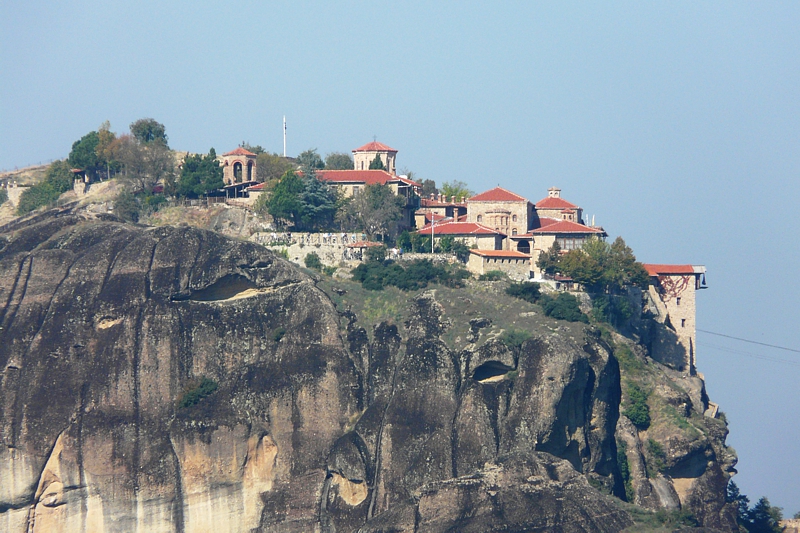
Wielki Meteor, Monastyr Przemienienia Pańskiego
The Holy Monastery of Great Meteoron

Meteory, monastyr Wielki Meteor. Meteora, The Monastery of Great Meteoron.

Monastyr Warłama
The Holy Monastery of Varlaam

Meteory, monastyr Warłama. Meteora, The Monastery of Varlaam.

Monastyr Świętego Stefana
The Holy Monastery of St. Stephen

Meteory, Monastyr Świętego Stefana. Meteora, The Monastery of St. Stephen.

Monastyr Rusanu, św. Barbary
The Holy Monastery of Rousanou/St. Barbara

Meteory, Monastyr Rusanu. Meteora, The Monastery of Rousanou.

Monastyr Świętego Mikołaja Odpoczywającego
The Holy Monastery of St. Nicholas Anapausas

Meteory, Monastyr Świętego Mikołaja Odpoczywającego. Meteora, The Monastery of St. Nicholas Anapausas.

Monastyr Świętej Trójcy
The Monastery of the Holy Trinity

Meteory, Monastyr Świętej Trójcy. Meteora, The Monastery of the Holy Trinity.

Meteory od strony wschodniej. Meteora from the east.

Meteory od strony wschodniej. Meteora from the east.